

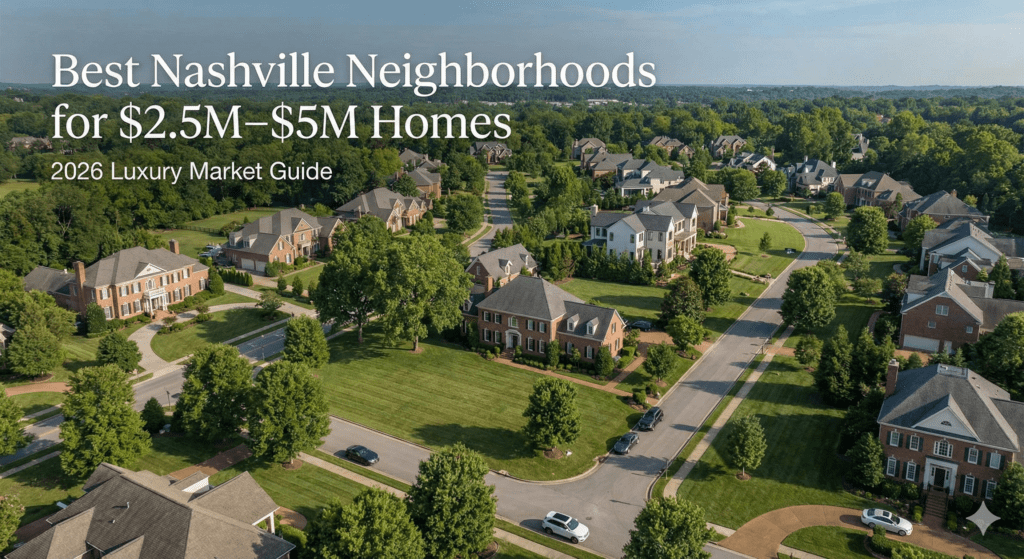
Nashville luxury is no longer a single market. It is a constellation of micro-markets with different lifestyles, different scarcity dynamics, and different definitions of value.
In the $2.5M–$5M range, buyers are not simply “moving up.” They are purchasing a position. Street position. Land position. Lifestyle position. And in 2026, the difference between an impressive house and an enduring investment is often decided by neighborhood selection, not finishes.
This guide focuses on the neighborhoods and communities that consistently perform at the top end, and how to choose the right one for the way you actually live.
What the $2.5M–$5M tier really means in 2026
At this level, the buyer conversation shifts from features to fundamentals.
What $2.5M typically buys
A $2.5M purchase is where Nashville starts to feel unmistakably luxurious, but it still comes with trade-offs.
You can expect a strong location and meaningful square footage. You may still compromise on one of the following: lot utility, turnkey condition, or street prestige. Many homes at this level are beautifully improved, yet not always fully reimagined.
What changes around $3.5M–$4M
This is the “balance zone.” Options widen. Quality becomes more consistent.
Street selection improves. Layouts become more modern. Renovations are more complete. It is also the point where buyers can more intentionally pick a lifestyle, rather than accept what the market gives them.
What $5M unlocks
At $5M, scarcity becomes the headline.
You are buying one of three things, sometimes two, rarely all three: prime positioning, privacy with land, or a truly irreplaceable home. Inventory is thinner. Many properties trade quietly.
If you want a $5M home with acreage, privacy, and a central address, be prepared for patience and precision.
How to choose the right neighborhood
There is no best neighborhood. There is only the right fit.
Use this framework before you tour.
Privacy vs proximity
If you want privacy, you will likely trade walkability. If you want proximity, you will likely trade land.
Land vs lifestyle density
Estate living and urban living are different products. Both can be luxurious. They do not solve the same problem.
Schools vs commute
For many families, school quality is the anchor. For others, time and access are a luxury.
Gated vs non-gated
Gated communities provide controlled access and an intentional social structure. Non-gated estates often offer more land, fewer restrictions, and a different type of discretion.
Nashville’s core luxury neighborhoods
Belle Meade
Belle Meade is legacy luxury. It is not a trend cycle. It is a long-term address.
The draw is simple: prestige, limited supply, and a built environment that cannot be replicated at scale.
Who it fits
Buyers who want long-term value, mature landscaping, and a market where scarcity is structural.
What $2.5M looks like here
At the entry point of this tier, Belle Meade often means older homes on meaningful lots, and a spectrum of renovation needs. Some are turnkey. Many are “good now, great later.”
The value is in the location. The finish level can be improved. The address cannot.
What $5M unlocks here
This is where Belle Meade becomes decisively estate-level. The lot utility improves. Privacy improves. Streets become more consistent in prestige.
This tier tends to be quieter. It is not uncommon for top offerings to circulate privately before public exposure.
Trade-offs to understand
Walkability is limited. Inventory is thin. Renovation timelines can be significant, especially for buyers who want a fully tailored result.
Oak Hill
Oak Hill offers a rare combination: estate-scale residential living that sits close to the city’s core.
It is also home to the Tennessee Governor’s Residence.
Who it fits
Buyers who want land, trees, and a truly residential environment without feeling far from the city.
What buyers get that is hard to replicate
Oak Hill is completely residential, with no commercial establishments inside the city. That single fact protects the “quiet” that high-net-worth buyers often chase.
The Radnor Lake adjacency effect
Oak Hill borders the Radnor Lake natural area, a 1,200-acre protected landscape with trails and wildlife observation.
That type of protected green edge tends to hold value because it cannot be “built out” later.
Trade-offs to understand
There is limited retail walkability by design. You are choosing serenity, not a town center.
Forest Hills
Forest Hills is for buyers who want their home to feel like a retreat.
This is where land, setback, and natural screening become the luxury feature set.
Who it fits
Buyers who value seclusion, mature trees, and a sense of distance from the city’s noise, even while remaining within metropolitan reach.
What the $2.5M–$5M tier looks like here
You will see a wider range of architecture and site characteristics, because the neighborhoods are less uniform. Some homes deliver exceptional privacy and scale. Others deliver scale, but with site limitations like slope, access roads, or narrower buildable areas.
Trade-offs to understand
A “great house” in Forest Hills can be extraordinary. A merely “good” one can feel isolated without being refined. Selection matters.
Green Hills
Green Hills is liquidity luxury. It is central. It sells.
This is where many buyers pay for access, convenience, and long-term buyer demand.
Who it fits
Buyers who want a central address, strong resale depth, and the ability to be close to daily life without being downtown.
What $2.5M tends to mean here
At the lower boundary of this tier, you are often buying an updated home or newer construction with a smaller lot footprint than estate neighborhoods.
What $5M unlocks here
At the top end, Green Hills becomes street-specific. Prime locations and custom construction separate themselves quickly. The market is more competitive because the buyer pool is broader.
Trade-offs to understand
Density and traffic are part of the price of being central. Micro-location is the difference between “good” and “exceptional.”
Williamson County luxury markets and communities
Brentwood
Brentwood is the flagship suburb for buyers who want space, schools, and predictability.
For many families, this is the cleanest luxury lifestyle: estate scale, strong neighborhoods, and long-term demand tied to education.
Who it fits
Families prioritizing a stable residential environment, larger homes, and school-driven resale.
The school-driven value factor
Downtown access can be negotiated. School quality is harder to replace. That is why Brentwood remains consistently in demand.
Trade-offs to understand
The lifestyle is quieter. The commute can be longer. For buyers who need walkability, Brentwood can feel too removed.
The Governors Club
The Governors Club is an example of “structured luxury.” It combines a gated environment with an amenity ecosystem built around golf.
The community is centered on a private Arnold Palmer Signature golf course.
Who it fits
Buyers who value controlled access, community structure, and amenities that create a built-in social calendar.
What to understand at this tier
At $2.5M–$5M, you are often purchasing not only the home, but also the lifestyle rules. That means HOA standards, community norms, and a shared approach to aesthetics and upkeep.
For many buyers, that structure is the feature.
Trade-offs to understand
You trade some autonomy for curated consistency. If you want total freedom to modify, build, or operate independently, a gated community can feel restrictive.
LaurelBrooke
LaurelBrooke is a guard-gated Franklin community known for a polished, residential feel and a strong emphasis on privacy.
Who it fits
Buyers who want a gated environment in Franklin, with a calm, established presentation and a community that feels intentionally composed.
What $2.5M–$5M tends to mean here
At this tier, buyers typically prioritize turnkey condition, community privacy, and cohesive surroundings. Homes often feel “finished” in a way that reduces renovation friction.
Trade-offs to understand
As with most gated communities, buyer flexibility is balanced against HOA standards and community expectations.
Franklin
Franklin offers something most luxury markets cannot manufacture: historic character paired with a highly livable, modern ecosystem.
Downtown Franklin has been designated a Great American Main Street.
Who it fits
Buyers who want charm, culture, and a lifestyle that includes walkable moments, restaurants, and community events.
What luxury looks like here
In Franklin, luxury can mean historic homes thoughtfully renovated, newer high-end construction near desirable corridors, or acreage living on the edges of town.
Trade-offs to understand
“Walkable” is a lifestyle, not a promise. Properties that are truly walkable to the heart of downtown are limited and priced accordingly.
Westhaven
Westhaven is a master-planned luxury community with strong internal lifestyle support.
Who it fits
Buyers who want amenities, neighbor connectivity, and an environment where daily life is designed to be convenient.
Trade-offs to understand
If you want acreage, significant separation, or a fully private estate feel, master-planned living may not deliver that product.
Leipers Fork
Leipers Fork is a lifestyle decision. It is not a commute decision.
This is where buyers choose acreage, privacy, and a rural luxury cadence.
Who it fits
Buyers who want land, quiet, and a more pastoral setting, and who are comfortable being outside the immediate Nashville orbit.
What $2.5M–$5M means here
This tier can deliver meaningful acreage and a property that feels genuinely rare. The product is often land-forward. Improvements vary. The right property depends on how you want to use the land.
Trade-offs to understand
Distance is real. Services are different. It is intentional living.
Off-market reality in the $2.5M–$5M tier
Some of the best opportunities never hit the open market.
Why. Discretion, convenience, and network effects.
If you are targeting the top end, preparation matters: proof of funds, decision clarity, and a willingness to move quickly when the right property appears.
Common mistakes buyers make at $2.5M–$5M
Buying finishes instead of location
Finishes can be replaced. Location scarcity cannot.
Underestimating street-level differences
Two homes a few blocks apart can perform differently on resale. Micro-market knowledge is not optional at this tier.
Confusing new construction with long-term positioning
A new house on a compromised lot is still a compromised lot. Longevity is earned through positioning.
FAQ
Is $2.5M enough for a true luxury home in Nashville?
Yes, in many pockets. Expect at least one compromise: lot, street, or turnkey condition.
Which neighborhoods offer the most privacy?
Belle Meade, Oak Hill, and Forest Hills typically lead for privacy and land-forward living.
Which areas tend to hold value best long-term?
Markets with structural scarcity and consistent demand tend to perform best. Central prestige (Belle Meade, Green Hills) and school-driven demand (Brentwood) often provide resilience.
Are gated communities worth it in Nashville?
They are worth it for buyers who value controlled access, consistency, and amenities. They are not worth it for buyers who want maximum autonomy.
Do the best homes really sell off-market?
Some do. Many “best fit” homes trade quietly because the seller prioritizes discretion or convenience.
Next step
If you are planning a $2.5M+ purchase in Nashville, the fastest path is not touring more homes. It is choosing the right neighborhood first.
Book a private neighborhood strategy conversation. We will align lifestyle, privacy, schools, and resale strength, then target inventory, including quiet opportunities as they become available.