


Quick Answer
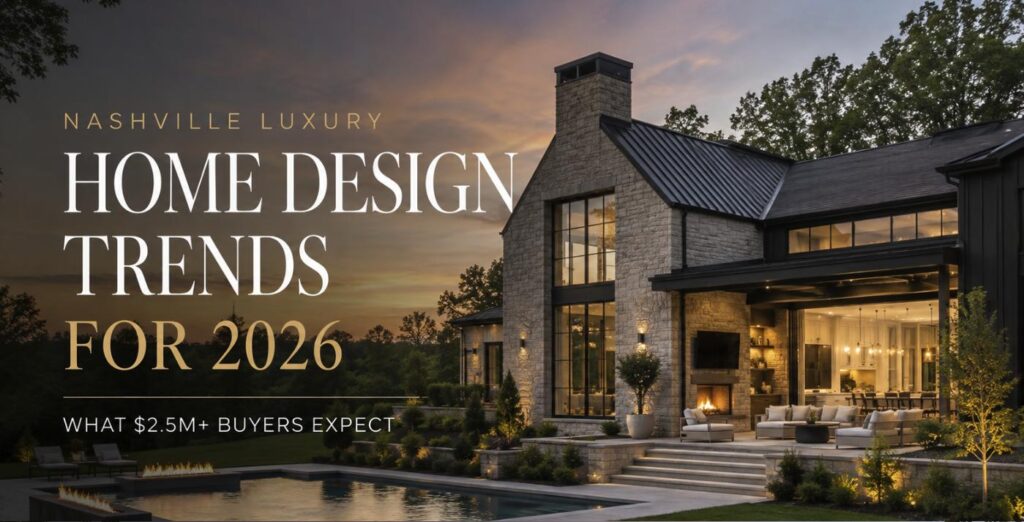
Nashville luxury home design in 2026 is moving toward warm minimalism, natural materials, wellness spaces, and outdoor living designed for the Tennessee climate. At the $2.5M–$5M level, buyers are placing more emphasis on timeless execution, quality craftsmanship, and thoughtful layouts than on size or trend-driven features. Those priorities look different across Belle Meade renovations, Forest Hills custom builds, and Franklin and Brentwood new construction.
On this page
- What Defines Nashville Luxury Design in 2026
- Warm Minimalism and Natural Materials
- Kitchens as the Center of the Home
- Wellness and Recovery Spaces
- Outdoor Living Built for a Tennessee Climate
- Technology That Disappears Into the Home
- Flexible Layouts for How Families Actually Live
- Character Over Sheer Size
- Efficiency and Systems: The Invisible Trend
- How These Trends Vary by Neighborhood
- What Buyers Should Prioritize vs. Ignore
- Frequently Asked Questions
What Defines Nashville Luxury Design in 2026
Luxury design in Nashville has matured.
I work with buyers and sellers at the $2.5M–$5M level across Belle Meade, Forest Hills, Green Hills, Brentwood, and Franklin. What I see at this level is a shift away from size and spectacle toward quality of execution, honest materials, thoughtful layouts, and design choices that are likely to remain appealing years from now.
That last point matters.
At this price level, a home is both a residence and a significant asset. A design choice that feels dated quickly can become a resale liability. A design choice that ages well can help protect the home’s position when it eventually comes back to market.
That is why the most useful way to look at Nashville’s 2026 luxury design trends is not simply to ask, “What’s popular?”
The better question is:
What are luxury buyers actually rewarding, and which design decisions are likely to hold up over time?
The answer is increasingly clear. Buyers are responding to homes that feel warm rather than sterile, intentional rather than oversized, and highly finished without feeling over-designed.
The trends below reflect that shift, along with how those preferences translate differently depending on the neighborhood, lot, existing housing stock, and whether you’re renovating or building new.
Warm Minimalism and Natural Materials
The stark, gallery-white contemporary look has lost ground in Nashville.
What replaced it is often called warm minimalism: clean lines and uncluttered spaces, but executed in materials with texture and depth. White oak flooring. Plaster and limewash finishes. Tennessee limestone and fieldstone. Painted brick. Natural stone counters with visible movement rather than uniform engineered surfaces. It is the same direction reflected in the architectural styles trending in Nashville luxury new builds.
The palette has warmed as well. Creams, warm whites, earth tones, and muted greens have replaced cool grays as the default at this tier.
What you gain: Warmth reads as livable in showings, photographs well without feeling sterile, and pairs naturally with both traditional and modern architecture. That flexibility matters at resale.
What you trade off: Natural materials cost more than their engineered imitations, and some, like unsealed stone and plaster, require more maintenance awareness than buyers coming from newer construction expect.
Why Stark Contemporary Struggles at Resale in Nashville
Nashville’s luxury buyer pool is broad: relocating executives, established local families, founders, and physicians. A severe contemporary interior narrows that pool. Warm, textural interiors keep the widest range of buyers engaged, and at resale, breadth of appeal is liquidity.
This is a judgment I share with sellers regularly: the question is not whether a design choice is beautiful. It is how many qualified buyers it removes from the room. It is the same lens I apply when advising on what $2.5M-plus sellers need to know before listing.
Kitchens as the Center of the Home
The kitchen remains the room buyers evaluate first and remember longest. What has changed is how the space is organized.
The pattern in current Nashville luxury construction is a two-part kitchen: a presentation kitchen that is open, clean, and architectural, backed by a working scullery or full prep kitchen that absorbs the mess of daily life. Walk-in working pantries, concealed appliance storage, and secondary dishwashers follow the same logic.
What you gain: The main kitchen stays composed for entertaining while the household actually functions behind it. For buyers who entertain, this layout has become a genuine differentiator.
What you trade off: A scullery consumes square footage and budget that older floor plans never allocated. In renovations of established Belle Meade or Green Hills homes, creating one often means rethinking the entire service core of the house, which is a meaningful scope decision, not a cosmetic one. For what that scope actually costs, see Realistic 2026 Custom Build Costs in Nashville.
Wellness and Recovery Spaces
Dedicated wellness space has moved from novelty toward expectation in new custom builds at the $3M+ level.
The common expression in Nashville is a wellness suite adjacent to the primary bath or fitness room: sauna, cold plunge, steam shower, and a properly ventilated space for equipment. Some buyers extend this to massage rooms or red light setups, but the core three (sauna, plunge, steam) are what come up in buyer conversations.
What you gain: For a growing segment of this buyer pool, wellness space is a daily-use feature, not a showpiece. In new construction, it is far cheaper to include than to retrofit.
What you trade off: These are mechanical-heavy rooms. Ventilation, drainage, and moisture management have to be engineered correctly, and poor execution creates problems that inspection will find at resale. A badly built wellness room is worse than none.
Outdoor Living Built for a Tennessee Climate
National design content treats outdoor living generically. In Nashville, climate is the design driver, and this is where local execution separates from imported ideas.
Middle Tennessee summers are hot and humid. The outdoor spaces that get used year-round here are covered, shaded, and ventilated: deep covered porches, screened rooms, ceiling fans, and fireplaces or heaters that extend the shoulder seasons. Fully open patios and pergolas photograph well and sit empty from June through September.
Covered and Screened Spaces
The covered outdoor living room, with a fireplace, television wall, and dining zone under roof, is the single most consistently requested outdoor feature I see from buyers at this level. Screened versions solve the insect reality of Tennessee evenings.
Pools, Kitchens, and Year-Round Use
Pools remain a strong expectation on Williamson County lots and larger Forest Hills and Oak Hill parcels, where the land supports them. On smaller urban lots in Green Hills, a pool is a case-by-case decision that depends on lot utility rather than default expectation.
Outdoor kitchens follow a simple rule: scale to the lot and to actual use. An over-built outdoor kitchen on a compact lot is one of the more common examples of cost that does not return.
Technology That Disappears Into the Home
The direction of smart home design at this tier is invisibility.
Buyers expect lighting control, climate zoning, security, audio, and network infrastructure to be present and to work. What they no longer want is visible complexity: wall-mounted panels in every room, exposed speakers, or systems that require a manual.
In practice, this means designing technology in during construction rather than layering it on afterward: structured wiring, centralized equipment rooms, recessed and architectural lighting fixtures, and interfaces that default to simple.
What you gain: Technology that disappears ages better. Visible tech dates a home to its install year faster than almost any finish choice.
What you trade off: Proper infrastructure costs real money during construction, and it is largely invisible at the open house. It pays off in daily use and at inspection, not in photographs.
Flexible Layouts for How Families Actually Live
The formal-room floor plan continues to lose ground to flexible space.
What Nashville luxury buyers consistently ask about: a genuine home office (often two), a secondary lounge or media space separate from the main living area, guest accommodation that offers real privacy, and rooms that can change function as families change. Formal dining survives at this tier, but it increasingly shares the plan with a larger casual eating zone rather than anchoring the house.
For relocating families, guest space carries extra weight. Out-of-town family visits are a structural feature of life for households that moved here from elsewhere, and a private guest suite is one of the most practical luxuries in the plan. If a move is what brings you here, see Luxury Relocation: Moving Your Family to Nashville in 2026.
Character Over Sheer Size
One of the quieter shifts at this tier deserves its own section: square footage has lost its status as the headline number.
A decade ago, luxury listings led with size, and buyers compared homes largely on it. Today, the buyers I work with at the $2.5M–$5M level ask a different set of first questions: ceiling heights, natural light, how the plan flows, what the lot allows, and whether the home has an architectural point of view. A 6,000 square foot home with generic bones now competes poorly against a 4,800 square foot home with proportion, light, and character.
What you gain: Prioritizing character over raw size usually means better lots, better light, and better long-term differentiation, since character is scarce and square footage is not.
What you trade off: Character is harder to evaluate than size. It requires touring with a critical eye and often benefits from a second opinion on what can and cannot be changed. Size is on the listing sheet; proportion is not.
For sellers, the implication is direct: a home’s character is now its marketing, and presentation choices that obscure it (dark window treatments, overfilled rooms, deferred exterior landscaping) cost more than they used to.
Efficiency and Systems: The Invisible Trend
Energy performance rarely appears on a luxury buyer’s stated wish list. It shows up anyway, twice: in the tour, and at inspection.
In the tour, it appears as comfort. Homes with properly zoned HVAC, quality windows, and real insulation feel different in a Tennessee August, and buyers register the difference even when they cannot name its source. At inspection, it appears as the systems report: sealed crawl spaces, water management, mechanical condition, and the presence or absence of generator readiness, which buyers ask about regularly after any stretch of severe Middle Tennessee weather.
New construction at this tier increasingly builds performance in as a matter of course. For owners of established homes in Belle Meade, Green Hills, and Forest Hills, systems modernization is among the least glamorous and most defensible investments before a sale, because it removes the inspection findings that become negotiation. Builder selection largely determines whether that performance is designed in or patched in later, which is one of the clearest differences among Nashville’s best luxury builders.
How These Trends Vary by Neighborhood
Design trends do not land uniformly across Nashville. The same buyer preference expresses differently depending on the housing stock and the street. If you are still narrowing corridors, start with the best Nashville neighborhoods for luxury families.
Belle Meade and Established Corridors
Belle Meade’s inventory skews older and architecturally significant. Here, 2026 design arrives through renovation: opening service cores, adding wellness and outdoor space, and modernizing systems inside homes whose exteriors and street presence are the point. The discipline is restraint. A renovation that fights the architecture of the house or the character of the street hurts value rather than helping it. It is also part of why so much of the best inventory here changes hands quietly, which I cover in how off-market deals work in Belle Meade and Forest Hills.
Forest Hills and Topography-Driven Design
Forest Hills and Oak Hill offer land and slope, and the strongest new builds there work with the topography: organic modern and transitional homes that step with the grade, orient to trees and views, and use stone and wood to sit naturally on their lots. This is where Nashville’s most architecture-forward custom work is happening. For how buyers weigh that against a more established setting, see Green Hills vs. Forest Hills.
Franklin, Brentwood, and New Construction
Williamson County new construction is where these trends appear in their most complete form: two-part kitchens, wellness suites, covered outdoor rooms, and integrated technology, all designed in from the start. The buyer consideration here is differentiation. When many homes in a corridor share the same feature set, execution quality and lot position separate them. Two comparisons worth reading alongside this section: what $3M buys in Nashville vs. Franklin vs. Brentwood and the best new construction at $2.5M–$5M.
What Buyers Should Prioritize vs. Ignore
A simple framework I use with buyers at this level:
- Prioritize: Fundamentals that cannot be changed later (lot, orientation, ceiling heights, floor plan logic), material quality in the rooms used daily, outdoor space engineered for this climate, and infrastructure (mechanical, electrical, network) done correctly.
- Be selective about: Trend-forward finishes that are expensive to reverse, highly personalized specialty rooms, and any feature whose main function is photography.
- Ignore: The pressure to check every trend box. The best homes at this tier express a clear, consistent point of view. Cohesion outperforms completeness.
Frequently Asked Questions
What are the biggest luxury home design trends in Nashville for 2026?
Warm minimalism with natural materials, two-part kitchens with working sculleries, dedicated wellness spaces, covered outdoor living designed for the Tennessee climate, and technology integrated invisibly into the home. Across all of them, buyers reward timeless execution over trend-chasing.
Is modern farmhouse still popular in Nashville?
It remains common in the housing stock, but buyer preference at the luxury level has shifted toward transitional design. Well-executed modern farmhouse on a good street still sells; the style simply no longer commands the default preference it held several years ago.
Do wellness rooms add value to a luxury home?
In new construction at the $3M+ level, wellness space aligns with what buyers now ask about and is inexpensive to include relative to retrofit cost. Execution matters: these are mechanical-heavy rooms, and poor ventilation or drainage turns an amenity into an inspection issue.
What design choices hurt resale in Nashville luxury homes?
Severe or highly personal design that narrows the buyer pool, trend-heavy finishes that date quickly, visible bolt-on technology, and outdoor spaces that ignore the climate. Breadth of appeal is liquidity at this tier.
Do design trends differ between Nashville and Williamson County?
The preferences are the same; the expression differs. Belle Meade and Green Hills see trends arrive through renovation of established homes. Forest Hills sees architecture-forward custom builds shaped by topography. Franklin and Brentwood new construction delivers the full 2026 feature set, where execution and lot position become the differentiators.
Next Step
If you are building, renovating, or evaluating a purchase at the $2.5M–$5M level, the design questions worth asking are about durability of appeal, not fashion.
I work with buyers and sellers across Nashville’s luxury corridors and can help you evaluate how a home’s design choices position it, both for how you will live in it and for how it will perform when you eventually sell.