

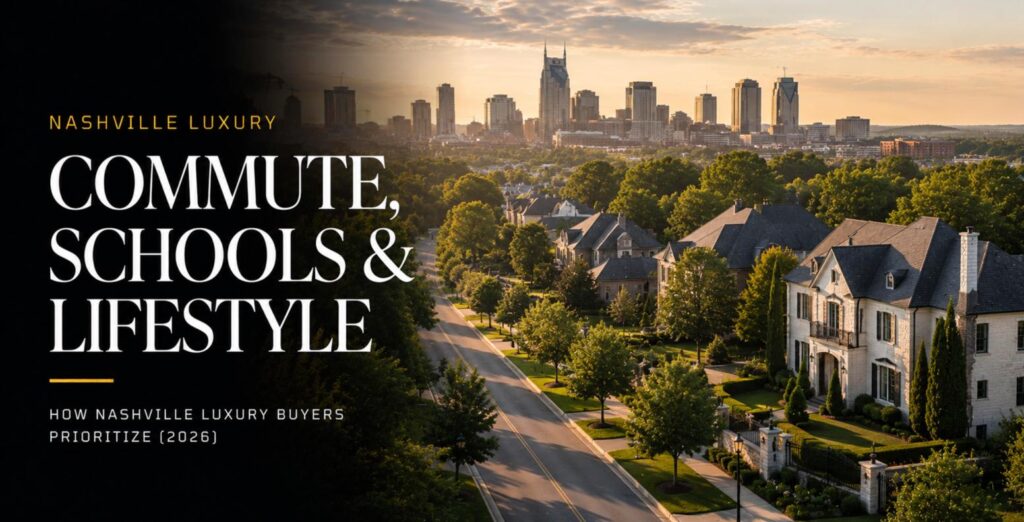

When relocating to Nashville, most luxury buyers eventually discover that every neighborhood decision comes down to three variables: commute, schools, and lifestyle. While it’s possible to optimize for two, very few buyers can maximize all three at once. Understanding these trade-offs helps families choose a neighborhood that aligns with their long-term priorities rather than short-term preferences.
Quick Answer
Most relocating luxury buyers can optimize for two of three variables—commute, schools, and lifestyle—but rarely all three. Families prioritizing highly regarded public schools often choose Williamson County and accept a longer commute. Buyers who prioritize being close to downtown Nashville typically live in Davidson County and often choose private schools. Long-term satisfaction usually comes from selecting the neighborhood that best matches how your family actually wants to live.
The Three Variables That Drive Every Decision
Every luxury relocation eventually comes down to three questions:
- How much commute are you willing to accept?
- What type of school access matters most?
- What kind of lifestyle do you want every day?
These three variables influence nearly every neighborhood recommendation I make.
I work with relocating families in the $2.5M to $5M price category throughout the year, and I’ve found that the families who make the best long-term decisions aren’t the ones trying to get everything.
They’re the ones who clearly understand which priority matters most.
Families who try to maximize all three often discover that Nashville simply doesn’t work that way.
Every neighborhood represents a different balance of convenience, education, space, privacy, and lifestyle.
The goal isn’t finding the perfect neighborhood.
It’s finding the right compromise for your family.
Commute: The Variable That Quietly Shapes Every Decision
Many relocating buyers underestimate how much commute affects daily life.
At first, an extra fifteen or twenty minutes may not seem significant.
After several years of school drop-offs, work schedules, evening activities, and weekend errands, those extra minutes begin to matter.
That’s why commute often becomes the deciding factor, even when buyers initially believe schools or home size are their highest priorities.
How Commute Maps Across Nashville
Under 20 Minutes to Downtown
Neighborhoods such as Belle Meade, Green Hills, Forest Hills, and Oak Hill generally provide the quickest access to downtown Nashville while maintaining a luxury residential setting.
These areas appeal to executives, physicians, entrepreneurs, and professionals who value minimizing time spent in traffic.
Approximately 20–35 Minutes
Brentwood occupies the middle ground.
It offers many of the advantages of Williamson County while remaining reasonably accessible to downtown Nashville for buyers with moderate commute tolerance.
Parts of Franklin can also fall within this range depending on location and traffic patterns.
35 Minutes or More
Outer Franklin neighborhoods and communities such as College Grove typically involve longer daily commutes.
In exchange, buyers often gain larger homesites, newer construction, and greater neighborhood amenities.
The Commute Trade-Off
Shorter commutes usually come with:
- Higher price per square foot
- Smaller lots
- More limited inventory
- Greater proximity to Nashville’s urban core
Longer commutes often provide:
- Larger homesites
- Newer construction
- More community amenities
- Strong access to Williamson County public schools
Neither choice is objectively better.
The right answer depends on how your family values time versus space.
Schools: The Variable That Becomes the Filter
For families with school-age children, education often becomes the first decision—not the last.
Instead of beginning with neighborhoods, many families begin by asking where they want their children to attend school.
That decision immediately narrows the search.
Nashville Proper vs. Williamson County
One of the biggest differences between Davidson County and Williamson County is how buyers approach education.
Davidson County
Public school quality varies by attendance zone.
Because of that, many luxury buyers living in Belle Meade, Green Hills, Forest Hills, and Oak Hill choose private education.
Schools such as University School of Nashville, Montgomery Bell Academy, Harpeth Hall, and Ensworth remain among the most sought-after options.
Williamson County
Communities like Brentwood and Franklin continue attracting relocating families because of Williamson County Schools.
Many buyers specifically choose these areas to access highly regarded public education while avoiding private school tuition.
Verify School Zoning Early
One mistake I regularly advise buyers to avoid is assuming that a home’s address guarantees a specific school assignment.
Attendance zones can change, and even homes on the same street may feed into different schools.
School zoning should always be verified before making decisions—not after a property is under contract.
Lifestyle: The Variable That Determines Long-Term Satisfaction
Commute and schools often drive the initial search.
Lifestyle determines whether you’re still happy with your decision five or ten years later.
I’ve worked with buyers who chose the “perfect” house on paper but realized after moving that the neighborhood didn’t match how they actually wanted to live.
The families with the highest long-term satisfaction aren’t necessarily the ones with the biggest homes.
They’re the ones whose neighborhood supports their daily routine.
Walkability vs. Privacy
One of the biggest lifestyle decisions is whether you value convenience or seclusion.
Green Hills offers one of Nashville’s most walkable luxury lifestyles, with shopping, restaurants, and everyday conveniences close by.
Forest Hills, on the other hand, offers larger lots, mature trees, and a quieter environment with significantly more privacy.
Neither is objectively better.
The right choice depends on how your family prefers to spend each day.
Urban Energy vs. Suburban Community
Belle Meade and Green Hills feel closely connected to Nashville’s urban core.
Brentwood and Franklin offer a more suburban lifestyle centered around neighborhoods, parks, community events, and schools.
Families relocating from cities such as New York, Chicago, or Boston often appreciate remaining close to the city’s activity.
Others are intentionally looking for a slower pace with more space.
Land vs. Convenience
Larger homesites usually require giving up some convenience.
Estate neighborhoods often mean longer drives for restaurants, shopping, and daily errands.
More convenient neighborhoods generally offer smaller lots and higher home density.
Neither lifestyle is right for everyone.
Turnkey vs. Character
Franklin offers a larger selection of newer construction with modern layouts and move-in-ready finishes.
Belle Meade and Forest Hills feature more historic architecture and established homes, but buyers may encounter renovation projects depending on the property.
Some families value turnkey convenience.
Others enjoy owning a home with architectural character and history.
What I’ve Observed
The happiest buyers are rarely the ones who found the “best deal.”
They’re the ones who bought a home in a neighborhood that fits their family’s routine.
Your daily experience matters far more than the features listed on a property brochure.
How to Prioritize the Three Variables
One of the most important conversations I have with relocating buyers isn’t about homes.
It’s about priorities.
Very few families can optimize for commute, schools, and lifestyle equally.
Most successful buyers intentionally prioritize two and accept reasonable trade-offs on the third.
If Schools Are Non-Negotiable
Focus on:
- Brentwood
- Franklin
Expect trade-offs in commute time, especially if your workplace is in downtown Nashville.
If Commute Is Non-Negotiable
Focus on:
- Belle Meade
- Green Hills
- Forest Hills
- Oak Hill
Expect higher price per square foot and consider whether private schools align with your family’s plans.
If Lifestyle Is Non-Negotiable
Start by defining what lifestyle actually means to your family.
Do you value walkability?
Privacy?
Community amenities?
Large lots?
Urban access?
Once that’s clear, choosing neighborhoods becomes significantly easier.
The Framework I Use With Relocating Buyers
Rather than beginning with listings, I encourage families to follow a simple framework.
Step 1: Rank Your Priorities
Decide whether commute, schools, or lifestyle matters most.
There isn’t a right answer.
There is only the answer that’s right for your family.
Step 2: Match Neighborhoods to Your Top Priority
Once your highest priority is clear, several neighborhoods naturally rise to the top while others become less relevant.
This immediately creates a more focused and efficient home search.
Step 3: Evaluate the Trade-Offs
Every neighborhood involves compromise.
Understanding those trade-offs before making an offer leads to far better long-term satisfaction.
Step 4: Think Beyond Closing Day
Don’t choose based solely on how a home feels during a showing.
Think about your daily commute, your weekends, your children’s routines, and how your family will use the neighborhood over the next five to ten years.
Those decisions have a far greater impact than a kitchen renovation or an extra bedroom.
Frequently Asked Questions
What matters most: commute, schools, or lifestyle?
There isn’t a universal answer.
Families with school-age children often prioritize education.
Executives with demanding work schedules frequently prioritize commute.
Lifestyle becomes the deciding factor once those primary needs are addressed.
Can I have excellent schools and a short commute?
It’s possible, but difficult.
Williamson County offers highly regarded public schools, though commuting to downtown Nashville generally takes longer.
Living closer to downtown shortens the commute but often means considering private school options.
How do I know which neighborhood fits my lifestyle?
Spend time there.
Walk the streets.
Visit local restaurants and parks.
Experience the neighborhood at different times of the day.
The atmosphere often tells you more than statistics ever will.
Should I prioritize commute or more space?
Be realistic about your daily routine.
Many buyers overestimate how much commuting they’re willing to tolerate.
Choosing a slightly smaller home with a better location often creates a better long-term experience than maximizing square footage.
What do most relocating luxury families prioritize?
In my experience, families with children most often prioritize school access first.
Professionals without school-age children frequently prioritize commute.
Lifestyle usually becomes the deciding factor once those primary needs are established.
Next Step
Every luxury relocation involves trade-offs.
The goal isn’t finding a neighborhood that excels at everything.
It’s finding the one that aligns with how your family wants to live.
If you’re planning a move to Nashville, I can help you evaluate neighborhoods, compare commute patterns, understand school options, and identify opportunities that match your priorities—including properties that may never reach the public market.
Before you begin touring homes, I recommend reading our guides on Luxury Relocation: Moving Your Family to Nashville in 2026 and The Best Nashville Neighborhoods for Luxury Families (2026) to build a stronger relocation strategy.
Book a relocation strategy conversation and let’s create a neighborhood plan that fits your family’s priorities for the long term.