

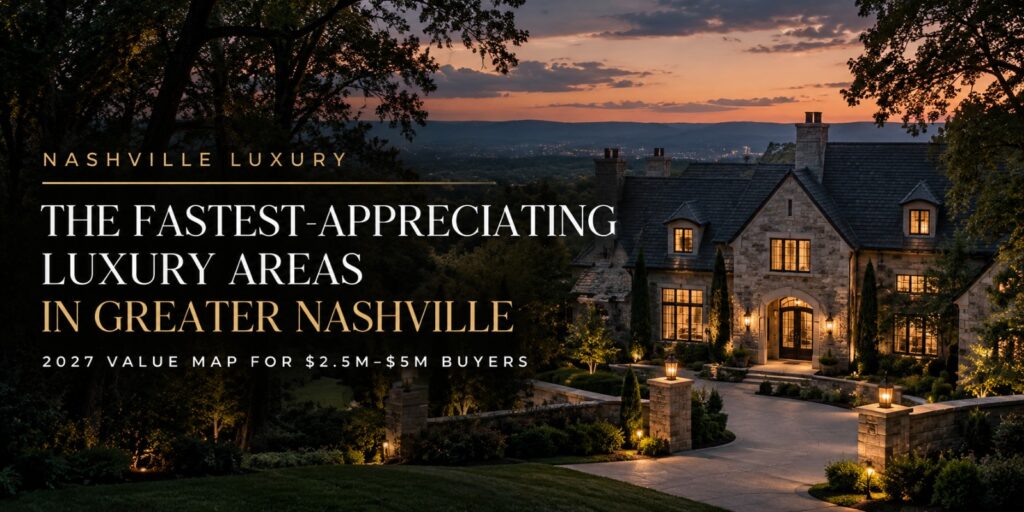

Quick Answer
For $2.5M to $5M buyers, the strongest Nashville appreciation signals heading into 2027 are concentrated in Forest Hills and Oak Hill, Belle Meade and West Meade, Green Hills, established parts of Brentwood and Franklin, and land-driven areas such as College Grove. The Gulch belongs in a separate high-rise category where building-level scarcity and development timing matter more than traditional neighborhood land scarcity.
Key Takeaways
- Appreciation should be evaluated through signals, not a promised percentage return.
- Scarce land and established demand remain the strongest long-term signals in Nashville’s most established luxury corridors.
- Forest Hills, Oak Hill, Belle Meade and West Meade benefit from limited estate inventory and established positioning.
- Brentwood, Franklin and College Grove offer a different value equation, with more land, newer inventory and continued regional growth.
- The Gulch requires a building-level analysis because condominium supply, development pipeline and amenities matter more than lot scarcity.
- A 2027 forecast should be treated as an observation point, not a guarantee.
Which Nashville Luxury Areas Have the Strongest Appreciation Signals for 2027?
There is no responsible way to promise that one Nashville neighborhood will appreciate by a specific percentage in 2027. The better question is which areas have the underlying conditions that can support durable value if current demand and supply conditions persist.
In August 2026, Redfin reported that Davidson County’s top 5% luxury segment had a median sale price of $2,282,711, with 220 luxury sales, a 20.9% year-over-year increase in sales, and a 72-day median time on market.
Those numbers describe the county’s luxury market, not a forecast for any individual neighborhood. They also show why neighborhood-level judgment matters. A luxury market can produce more transactions while still giving buyers more negotiating room, particularly when inventory is expanding.
The strongest areas therefore tend to be those where the underlying asset is difficult to reproduce: a well-positioned lot, an established street, mature landscaping, proximity to major employment and lifestyle destinations, or a building with a genuinely differentiated position.
Forest Hills and Oak Hill: Where Land Scarcity Matters Most
Forest Hills and Oak Hill stand out because land is a central part of the luxury proposition. Large wooded parcels, established estate settings and the ability to create or substantially renovate a custom home give these areas a form of scarcity that is difficult to manufacture elsewhere.
The important distinction is between raw acreage and useful land. A property with substantial acreage does not automatically have stronger value if topography, drainage, access or building restrictions reduce its practical utility. For a $2.5M to $5M buyer, the better question is whether the land creates privacy, usable outdoor space and future flexibility without compromising the home itself.
These areas also benefit from their proximity to Green Hills, Belle Meade and central Nashville while retaining a more estate-oriented setting. That combination is difficult to replicate as Nashville continues to develop.
Belle Meade and West Meade: Established Positioning and Limited Repetition
Belle Meade’s strength is not simply prestige. It is the depth of its established identity and the limited ability to recreate that environment somewhere else.
West Meade adds a different version of the same argument. Established streets, larger properties in selected pockets and access to Nashville’s western luxury corridors create a market where the land and location can carry significant weight alongside the house.
The strongest properties in these areas are not necessarily the newest. A well-positioned older home with meaningful architectural character, useful land and thoughtful renovation can compete effectively with new construction when the overall property feels coherent.
That is one reason established luxury corridors deserve to be evaluated separately from areas where most value depends on new development.
Green Hills: Location Scarcity With a Different Form of Land Constraint
Green Hills is a different proposition because the value equation is heavily influenced by location. Buyers are paying for proximity to established retail, private schools, employment centers, major roads and the broader Nashville lifestyle.
The area also has a complicated planning environment. Nashville’s Green Hills-Midtown community planning area contains nine Urban Design Overlays, the most of any Nashville community, which illustrates how development controls can shape what can and cannot be built. (Source: Metro Nashville Planning Department)
The result is not simply scarcity of land. It is scarcity of sites that combine location, buildability, street quality and an appropriate finished-home product.
For buyers comparing Green Hills with Forest Hills, the distinction is important. The two areas can overlap geographically in a buyer’s search, but their value propositions are not identical. See Green Hills vs Forest Hills: Why Executives Choose Each (2026).
Brentwood and Franklin: Growth, Land and Established Demand
Brentwood and Franklin have a different appreciation profile from Nashville’s older estate corridors. They offer larger development areas, established residential communities and continued demand from households that prioritize schools, space and access to employment centers.
Franklin’s municipal planning framework explicitly connects growth management, infrastructure investment, preservation and long-term economic vitality. That matters because growth without planning can create supply without necessarily creating durable neighborhood value. (Source: City of Franklin)
Brentwood is also moving through a long-range planning process, the Brentwood 2040 Plan, focused on growth, development, transportation, infrastructure and quality of life. That makes planning discipline an important variable to watch rather than simply assuming that population or construction growth equals appreciation. (Source: City of Brentwood)
The $2.5M to $5M buyer should therefore distinguish between areas with genuine scarcity and areas where future value depends more heavily on how successfully new supply is absorbed.
College Grove: Land, Community and Finite Luxury Supply
College Grove sits further south and operates on a different luxury model. The appeal is tied to land, private-community amenities, newer estate construction and Williamson County positioning.
The Grove is particularly relevant because its own community materials describe the development as being in its final phase with limited homes remaining.
That type of finite supply can matter. When a community has a defined physical footprint and a limited remaining release, the future value discussion shifts from unlimited new construction to the quality and scarcity of the remaining product.
The Grove also describes custom homes ranging from $3.5 million to more than $8 million. For a $2.5M to $5M buyer, that places College Grove within a luxury environment where finished-home quality, community positioning and lot characteristics can be evaluated together.
The Gulch: A Different Kind of Appreciation Case
The Gulch should not be evaluated using the same framework as Forest Hills or Belle Meade. There is no meaningful comparison between an estate lot and a high-rise residence when the underlying supply dynamics are completely different.
For a Gulch property, the relevant questions include building quality, views, floor plan, services, HOA structure, amenities, location within the district and the amount and quality of competing residential supply.
That makes building-level scarcity more important than neighborhood-wide land scarcity. The strongest opportunity may be a residence in a building whose positioning remains differentiated after new projects deliver, rather than simply buying into the newest tower.
What Would Weaken the 2027 Appreciation Read?
Every one of these areas has risks. A rise in available luxury inventory could reduce pricing power. A new wave of construction could weaken scarcity in a particular submarket. Changes to zoning or development policy could alter the character of an established corridor. Higher carrying costs or a prolonged period of slower luxury demand could also reduce liquidity.
The important point is that a neighborhood does not need to stop being desirable for appreciation to slow. A market can remain fundamentally strong while prices move sideways because buyers have more alternatives.
That is why 2027 should be treated as an observation period. The question is whether the underlying scarcity, demand and supply characteristics remain intact.
How Should a $2.5M to $5M Buyer Use This Ranking?
The map is useful as a starting point, not as a substitute for property-level analysis.
A buyer should compare the specific lot, street, architecture, condition, renovation quality, future competition and resale pool of each property. Two homes in the same neighborhood can have very different long-term value profiles.
The strongest purchase is often the property whose advantages would be difficult for a future competitor to reproduce.
Alex Brandau’s Perspective
For a $2.5M to $5M property, I do not look at appreciation as a single forecast number. I look at what would make the property difficult to replace five or ten years from now.
That distinction matters because a strong neighborhood cannot compensate indefinitely for a compromised property. The land, street, architecture, condition and future buyer pool still have to work together.
Frequently Asked Questions
Which Nashville luxury neighborhoods have the strongest appreciation potential in 2027?
Forest Hills, Oak Hill, Belle Meade, West Meade, Green Hills, selected parts of Brentwood and Franklin, and land-driven areas such as College Grove show different combinations of scarcity, established demand and growth signals. The ranking depends on which type of value the buyer is seeking.
Is Nashville luxury real estate expected to appreciate in 2027?
There are signals worth watching, but appreciation should not be stated as a certainty. Inventory, demand, interest rates, employment, new construction and buyer confidence can all change the outcome.
Is land or location more important for Nashville luxury appreciation?
Neither is universally more important. Land scarcity can create durable value in estate-oriented areas, while location scarcity can be more important in established urban luxury corridors.
Does new construction help or hurt appreciation?
It can do either. New construction can strengthen an area by improving infrastructure and attracting demand, but excessive competing supply can reduce scarcity and negotiating power.
Is College Grove a strong luxury investment area?
College Grove has a strong luxury lifestyle and land-driven value proposition, particularly in established private communities. Buyers should still evaluate the specific community, lot and future supply rather than treating the entire area as one market.
Should buyers focus on 2027 appreciation when purchasing a luxury home?
Appreciation can be one consideration, but a $2.5M to $5M purchase should also work as a residence. The best property usually combines lifestyle fit with characteristics that support future resale.
A Better Way to Think About Nashville Luxury Appreciation
The strongest Nashville luxury markets are not necessarily the ones with the most development or the fastest population growth. They are the places where demand has depth and the physical characteristics that create desirability are difficult to reproduce.
The next step is to understand the signals themselves before applying them to a specific property: Nashville Neighborhoods With the Strongest Long-Term Appreciation Signals for 2027.
For buyers focused on land and future custom construction, the lot itself deserves a separate analysis: Where Builders Are Paying Premiums for Lots Going Into 2027.
For buyers more interested in emerging development and infrastructure, the near-term growth story is different: Nashville Luxury Zones Expected to Grow Fastest in 2027.
And for buyers considering Williamson County, the value case depends on a different combination of schools, land, newer inventory and regional growth: Why Williamson County Is Poised to Surge in Luxury Value by 2027.
For sellers, these same signals matter when deciding how much of the home’s value is structural and how much depends on current market conditions: How to Successfully Sell a $2.5M–$5M Home in Nashville (2027 Edition).