
Quick Answer
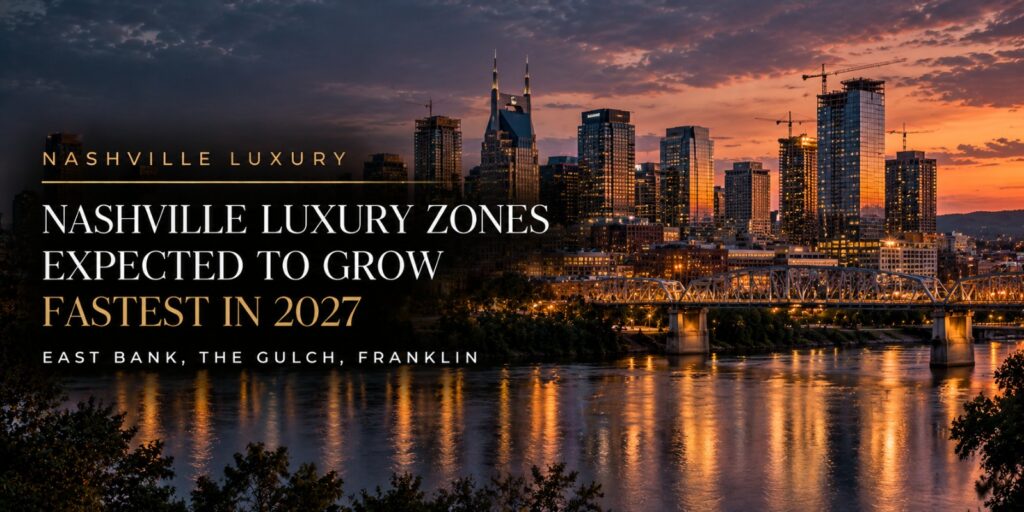
The strongest near-term growth signals for 2027 are concentrated around Nashville’s East Bank and River North, the Gulch and downtown high-rise pipeline, Franklin, and selected growth-oriented areas of Williamson County. Growth should not be confused with guaranteed appreciation. The useful question is where infrastructure, employment, residential development and amenities are changing the buyer’s choices fastest.
This article is part of the October value series anchored by The Fastest-Appreciating Luxury Areas in Greater Nashville (2027 Update).
Key Takeaways
- East Bank is the clearest large-scale redevelopment story.
- The Gulch and downtown have a significant residential construction pipeline.
- Franklin combines infrastructure investment with continued residential development.
- Brentwood’s growth story is more controlled and infill-oriented.
- College Grove continues to add luxury residential relevance through established private communities.
- More development can increase desirability while also increasing supply, so growth and appreciation must be evaluated separately.
What Makes a Nashville Luxury Zone a High-Growth Area?
Growth is easiest to identify through visible changes in infrastructure, employment, residential supply and amenities. It does not automatically mean home values will rise. A growth zone can attract substantial investment while simultaneously producing enough new housing to give buyers more choices. That distinction is especially important for the $2.5M to $5M market.
Realtor.com reported in August 2026 that Nashville active listings were up 12.6% year over year and that more than 22% of listings carried a price reduction. Those conditions reinforce the need to distinguish physical growth from pricing power.
East Bank and River North: Nashville’s Largest Structural Growth Story
The East Bank is the clearest example of a long-duration transformation rather than a simple neighborhood expansion.
Metro describes the East Bank as a 550-acre area along the Cumberland River that includes 130 acres of Metro-owned land, with The Fallon Company selected to develop the first 30 acres of Metro-owned land. (Source: Metro Nashville, East Bank Development)
The scale matters because large infrastructure projects can change how surrounding neighborhoods connect to downtown, East Nashville, Germantown and the riverfront.
Oracle is another major employment component. Nashville’s East Bank Development Authority reported in April 2026 that Oracle’s planned campus will eventually house 8,500 jobs.
The new Nissan Stadium is another East Bank anchor. The East Bank Development Authority reported the project on schedule to open in February 2027.
The important point for luxury buyers is that East Bank growth is not a single residential project. It is an interconnected combination of employment, transportation, public infrastructure, entertainment, residential development and public space.
The Gulch and Downtown: High-Rise Growth With Building-Level Analysis
The Gulch remains one of Nashville’s most important high-rise luxury zones, but its growth needs to be evaluated differently from an estate neighborhood.
The Downtown Nashville Partnership‘s current development map lists the Paramount as a 60-story residential tower with delivery scheduled for 2028, Pendry Hotel & Residences as a 30-story project with 146 residences and delivery scheduled for 2027, and Nashville Edition Hotel & Residences as a 28-story project with 84 condominiums and delivery scheduled for 2028.
Those projects can increase the quality and depth of Nashville’s luxury condominium market. They also create future competition.
For a $2.5M to $5M buyer, the question is therefore not simply whether the Gulch will grow. It is which buildings will remain differentiated after the next wave of supply arrives.
Franklin: Growth With Planning and Infrastructure Behind It
Franklin is one of the most important growth markets within the $2.5M to $5M search because it combines residential demand with significant municipal infrastructure planning.
Franklin’s FY2026-27 proposed budget reported a record $1.7 billion in private investment over the previous two years and highlighted major transportation projects including Mack Hatcher Parkway Southeast and McEwen Road improvements. (Source: City of Franklin, FY2026-27 proposed budget)
The city’s 2025 Development Report also recorded 3,225 dwelling units approved during 2025 and 13,203 approved units yet to be built. (Source: City of Franklin, 2025 Development Report)
That second figure is especially important to interpret correctly. It demonstrates substantial future supply, not guaranteed future appreciation. For buyers, the implication is that Franklin’s growth can improve amenities, infrastructure and economic connectivity while also creating more choices. The specific submarket and property therefore matter more than the citywide growth story.
Brentwood: Mature Growth and Infill
Brentwood has a different growth profile. It is not a blank-slate expansion market.
Its long-term planning process, the Brentwood 2040 Plan, is focused on growth, development, transportation, infrastructure, public services and quality of life, and the city’s residential infill rules demonstrate that redevelopment is becoming a more formal part of the housing conversation. (Source: City of Brentwood)
For luxury real estate, that means the growth story is more about how established neighborhoods evolve than about rapid new subdivision expansion.
College Grove: Luxury Growth Within Established Communities
College Grove represents a more specialized growth story. The market is increasingly relevant to luxury buyers because private communities combine larger homes, amenities, newer construction and Williamson County positioning.
The opportunity is different from East Bank or Franklin. Rather than betting on a broad urban redevelopment cycle, the buyer is evaluating whether the community’s established luxury product, remaining supply and surrounding growth can support long-term demand.
The Grove describes its community as being in a final phase with limited homes remaining. That finite supply is one reason the community deserves attention within the broader College Grove luxury market.
Growth Does Not Equal Appreciation
This distinction should remain central to any 2027 forecast. Growth can create more demand, but it can also create more supply. Infrastructure can make a location more attractive while simultaneously opening additional land to development.
The strongest growth zones for a buyer are therefore not necessarily the places with the most construction. They are the places where new investment improves the location while the underlying luxury product remains differentiated.
What Should Buyers Watch in 2027?
Watch four things. First, whether major infrastructure projects remain on schedule. Second, whether employment growth translates into actual household demand. Third, whether new residential supply is being absorbed without excessive concessions. Fourth, whether the quality of new construction is improving the luxury product or simply adding more inventory.
Those indicators will tell buyers more than a headline about a new development.
Alex Brandau’s Perspective
I pay close attention to development that changes how people actually move through Nashville and where they choose to spend their time.
The important distinction is between development that changes a property’s surroundings and development that merely adds more buildings. The former can create a durable location advantage. The latter can create both opportunity and competition.
Frequently Asked Questions
Which Nashville area is expected to grow fastest in 2027?
The East Bank is the clearest large-scale transformation, while Franklin and selected Williamson County areas have substantial ongoing growth. The Gulch also has a significant high-rise pipeline.
Does rapid development mean home prices will rise?
No. Development can increase demand and supply at the same time.
Why is the East Bank important to luxury real estate?
Its scale combines employment, infrastructure, stadium development, residential construction, public space and downtown connectivity.
How will the new stadium affect the East Bank?
The stadium is one component of the broader East Bank transformation. Its importance comes from the infrastructure and surrounding development that can follow a major anchor project.
Is Franklin becoming overbuilt?
Franklin has substantial future housing supply, so that question deserves attention. The answer will depend on how quickly new units are absorbed and where that supply is concentrated.
Is the Gulch still a good luxury condominium market?
It remains an important luxury high-rise market, but each building should be evaluated against current and future competing supply.
The Growth Areas That Deserve the Closest Watch
The near-term map is different from the long-term appreciation map. East Bank and River North are transformation stories. The Gulch is a building-level high-rise story. Franklin is a growth-and-infrastructure story. Brentwood is an infill story. College Grove is a community-driven luxury story.
Williamson County adds another layer because schools, land and population growth interact with the luxury market differently: Why Williamson County Is Poised to Surge in Luxury Value by 2027.
For land-focused buyers and builders, growth also changes the value of redevelopment opportunities: Where Builders Are Paying Premiums for Lots Going Into 2027.
Book a private Nashville growth strategy conversation with Alex.